
Turning an Offering Circular into Model Inputs Without Losing a Day

The Real Bottleneck in Structured Finance
In structured finance, the time sink is rarely the math. It's the translation step: taking an Offering Circular and converting it into a small set of auditable assumptions you can actually run through a model.
The Offering Circular matters, but it is not the whole universe. You still rely on a wider document set (indenture, confirmations, account and servicing agreements) and on data (collateral tapes, stratifications, trustee and investor reports). What the Offering Circular does do is define a dense layer of governing language and cross-references that can make simple questions take longer than they should.
So the bottleneck is not "reading faster." It's operationalizing the mechanics with fewer missed links and fewer manual steps.
Regulators have described the same underlying challenge in more formal terms: disclosure documents are information-rich, but not naturally structured for analysis at scale, which is why text-mining approaches are attractive. (See ESMA reference in the footnotes.)
A Workflow That Treats This as an Engineering Problem
The most reliable way I've found to reduce the translation tax is to make the extraction repeatable.
Instead of approaching every deal as a fresh reading project, you define a reusable template that forces the same modeling questions to be answered each time: reserves and support, triggers, priority of payments, hedge mechanics, and the counterparty remedies that matter in stress.
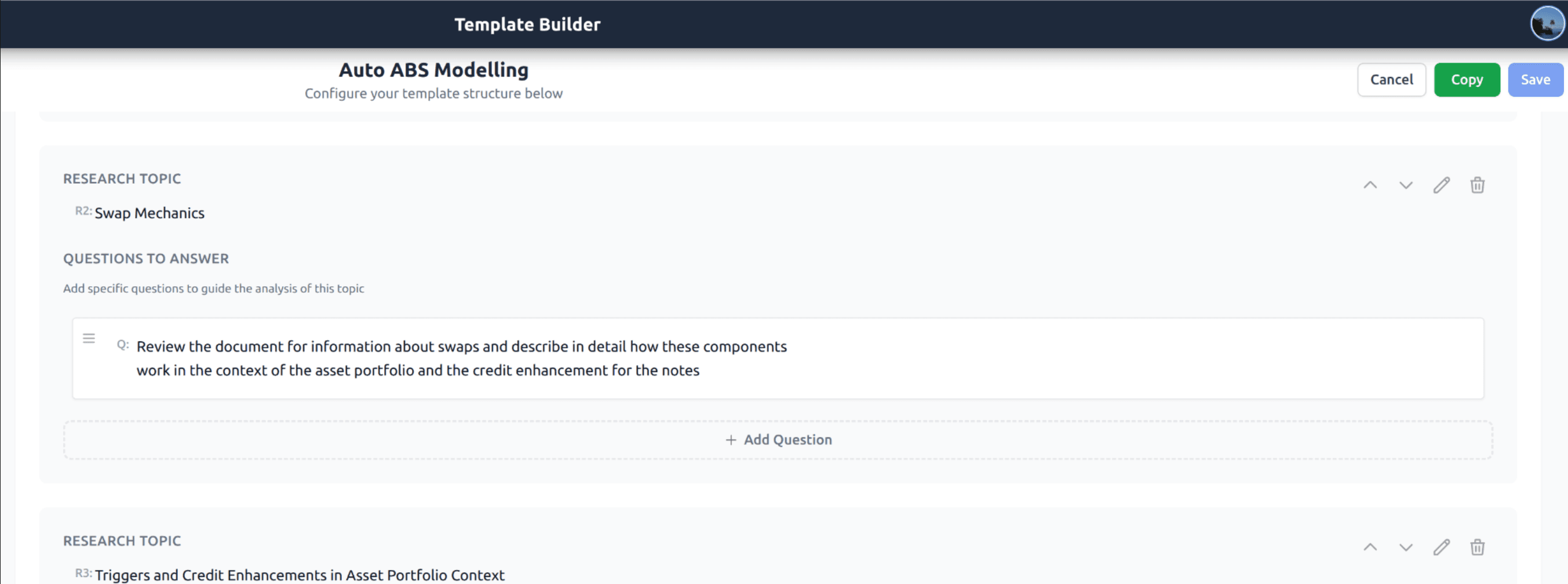
This is less about automation and more about consistency. The template turns "what should we look for?" into something explicit, which is exactly how you reduce analyst-to-analyst drift.
What "Model Ready" Actually Means Across ABS, RMBS, CMBS, and CLO
Across asset classes, the early questions are stubbornly similar:
- Where does cash flow, in order, and what changes when triggers breach?
- What support exists, how is it sized, and when does it actually fund?
- What counterparty exposure is embedded, and what are the downgrade or replacement remedies?
- Which definitions change the meaning of a trigger or a payment step?
This matches how structured finance analysis is usually framed: collateral risk plus structural mechanics plus counterparty exposure and mitigants. (See the EthiFinance and S&P references in the footnotes.)
Reserves: Where Small Wording Creates Big Modeling Differences
Reserves are a perfect example of why structure-first extraction matters. Two analysts can agree "there is a reserve" and still build materially different models if they miss any of the following:
- Whether the reserve is funded at closing or only after a trigger
- Whether it can be applied to interest shortfalls or only to fees
- Whether it amortizes, steps down, or stays static
- Where it sits in the priority of payments
When reserve mechanics are surfaced as a single object, purpose, trigger, required amount logic, and form of funding, you can sanity-check the economics before you commit to a full build.
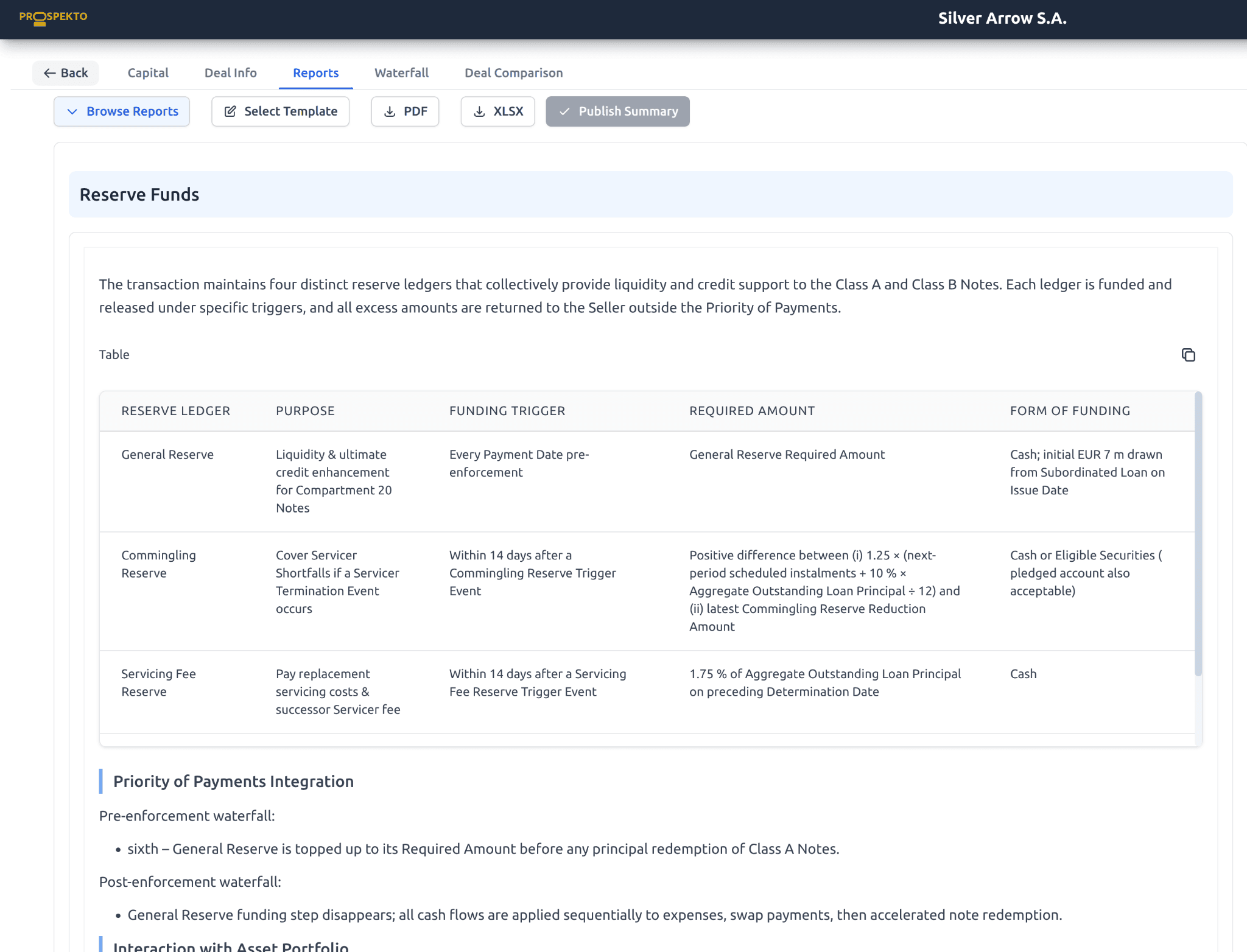
A detail I like here is that placement is treated as first-class information. It's hard to overstate how often "support exists" turns into "support exists, but not when you assumed."
The Hedge: Not a Footnote, a Scenario Driver
In many structures, especially where you are converting fixed receipts into floating liabilities, the hedge is a core cashflow component. The model-relevant questions aren't philosophical. They're mechanical:
- What is the notional and how does it amortize?
- What are the legs and day-count conventions?
- What happens on downgrade?
- Where do swap payments sit in priority, including termination scenarios?
This is exactly why counterparty criteria in structured finance focuses so heavily on exposures to derivative providers and the mitigants that keep cashflows stable under stress: collateral posting, replacement, and related remedies.
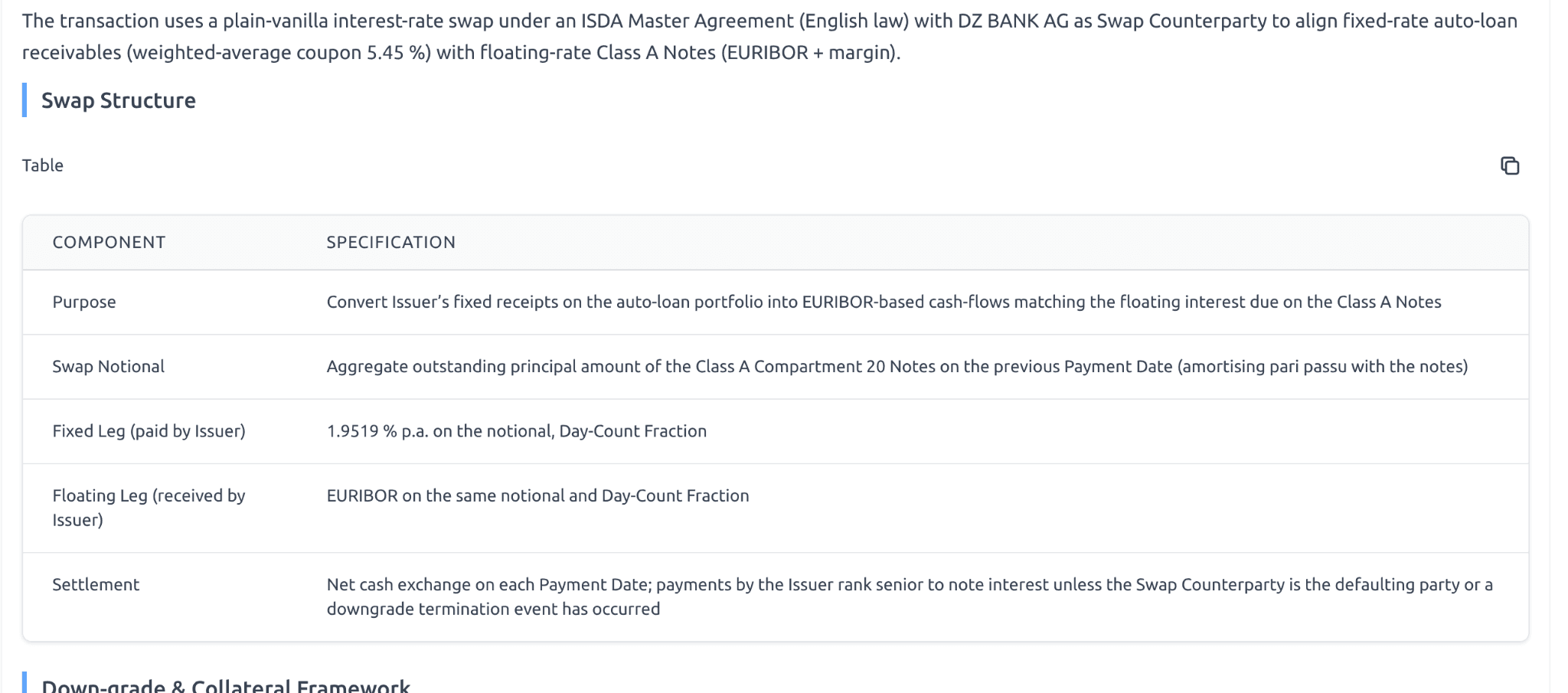
The value, in practice, is not "learning the hedge exists." It's being able to model it correctly without a scavenger hunt through definitions and cross-references.
Why the Excel Output Matters, Quietly
Excel is still where a lot of early underwriting work happens. That's fine. The risk is the manual part: re-keying tables, rebuilding waterfalls, and copying formulas out of documents under time pressure.
Spreadsheet research has long shown that errors are common, even among experienced users. The goal is not to be dramatic about it, just realistic: fewer manual transcription steps generally means fewer silent inconsistencies.
So when the extracted mechanics land as structured tables, the work shifts away from transcription and toward judgment: scenarios, sensitivities, and the questions that actually change your view of the deal.
The Compounding Effect: Repeatability Turns One Deal into a Pipeline
The biggest improvement is not saving time on a single transaction. It's building a consistent surface for comparison across deals.
When the same template reliably exposes the same classes of mechanics, you can compare structure across ABS, RMBS, CMBS, and CLO with less reinvention. Then you spend your scarce human time where it matters: validating the critical clauses, challenging the assumptions, and pricing risk.
References
- ESMA (TRV Risk Analysis), "Parsing prospectuses: A text-mining approach" (ESMA50-164-6327)
- EthiFinance Ratings, "Structured Finance Rating Methodology – General" (CRA_140)
- S&P Global Ratings, "Counterparty Risk Methodology" (Structured Finance)
- Raymond R. Panko, "Spreadsheet Errors: What We Know. What We Think We Can Do." (arXiv:0802.3457)
Samuel Griek
I'm Sam Griek, founder of Prospekto. I design and build bespoke agentic AI systems: autonomous agents that read complex documents, reason about their contents, and execute precise workflows in regulated environments. My background is 20-plus years in data and application engineering across Fortune 200 companies and startups. For the last three years I've been focused on structured finance, where I find the operational bottlenecks that cost teams hours of manual work and build agent systems that eliminate them. Your best people should be making decisions, not preparing to make decisions.