
When the SaaS Storefront Loses Foot Traffic: What the Evidence Says About AI
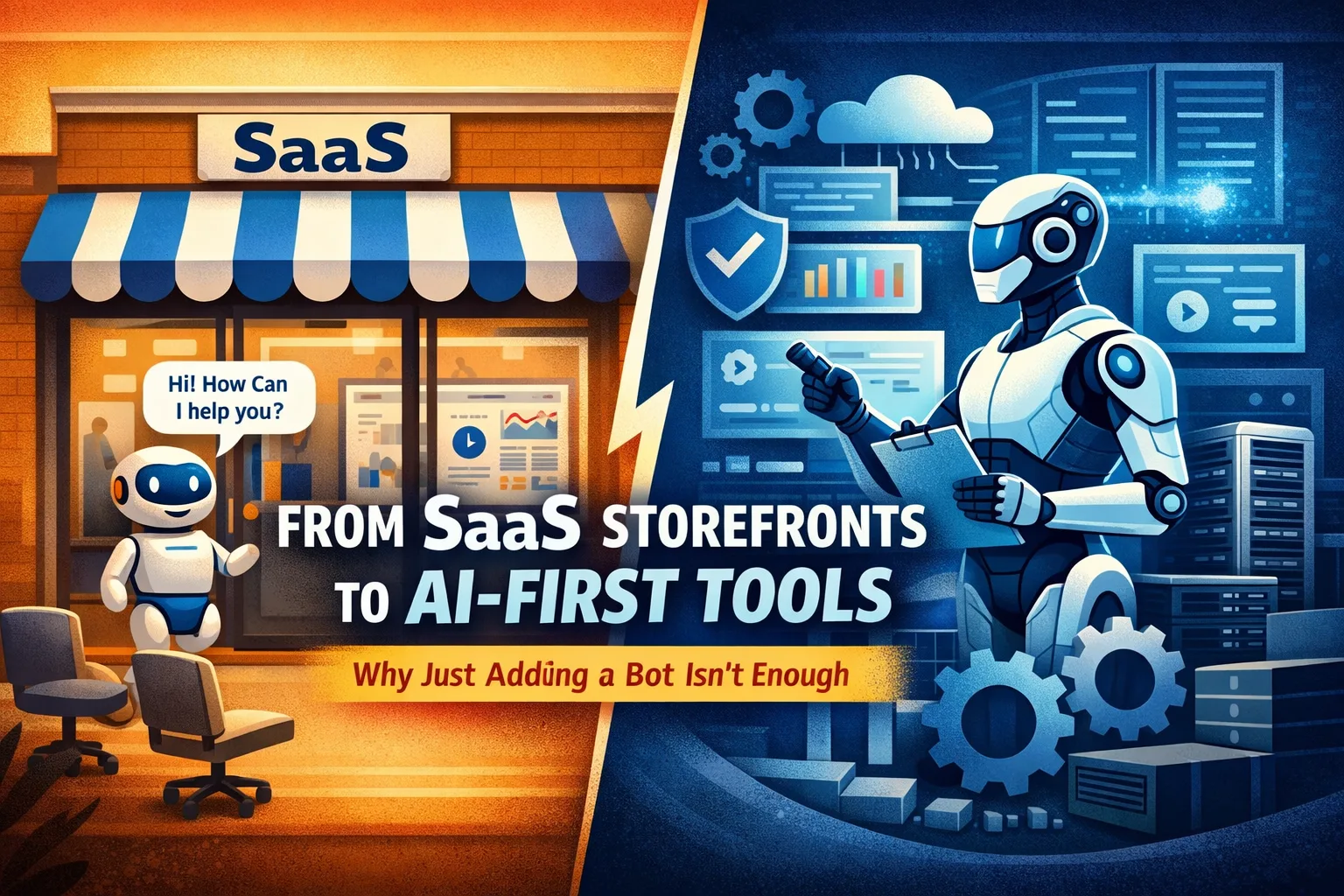
When the “SaaS Storefront” Loses Foot Traffic: What the Evidence Actually Says About AI, Obsolescence, and the Bot-Glue Trap
SaaS is not disappearing. But the old SaaS bargain, paying per seat for a screen humans click all day, has started to look less like a durable lease and more like a month-to-month pop-up. AI is changing where value accrues, and it’s doing it in a way that makes “we added a chatbot” feel like putting a neon sign on a shop that no longer owns the street.
Picture a busy mall. For years, SaaS companies won by building the nicest storefront: dashboards, forms, workflows, and a pricing model tied to how many people walk through the door. Now AI agents show up like personal shoppers who don’t browse displays; they go straight to inventory, policies, and checkout. If your business is mostly the display window, the agent walks past you. If your business is the warehouse, the supply chain, and the rules that keep everything compliant, the agent becomes your best customer.
Here are four anchor readings that, taken together, best support (and constrain) the “AI makes SaaS obsolete” thesis:
- Reuters on AI pressure and valuation risk for SaaS, including shifting pricing dynamics and competitive pressure. (Reuters)
- Bain on agentic AI disrupting SaaS and what incumbents must “own” to avoid being replaced (data, standards, outcome pricing). (Bain)
- Gartner predicting large-scale cancellation of agentic AI projects when costs/value/risk controls don’t pencil out (a warning label for “just add an agent”). (Gartner)
- AlixPartners (as reported) describing a “squeeze” on midmarket software firms as AI-native entrants and platform giants compress differentiation and retention. (Business Insider)
Setup: the “SaaS is failing” claim, what’s true, and what’s sloppy
If “failing” means “everyone stops buying SaaS,” the evidence does not support it. Spending can keep rising even while the playbook breaks, especially if price increases, vendor consolidation, and cloud expansion continue. For example, a 2025 SaaS management report citing Gartner forecasts puts worldwide SaaS spend growing into 2025. (Zylo)
But if “failing” means “the median SaaS company can’t rely on the old growth/valuation dynamics,” there’s plenty of evidence that the market regime changed: multiples compressed, and investors became less forgiving of slow growth and weak differentiation. (Bessemer Venture Partners) The Reuters view is blunt: AI can take a bite out of software valuations by lowering barriers to replicate functionality and by pushing vendors away from predictable seat-based revenue. (Reuters)
So the mall is still open. But rent is rising, foot traffic patterns changed, and a lot of tenants are discovering that “nice storefront” is no longer enough.
Tension: how AI actually makes parts of SaaS obsolete
The strongest version of the “AI makes SaaS obsolete” argument is not “apps vanish.” It’s: interfaces and workflows get commoditized, and differentiation migrates down-stack.
You can see this idea echoed in credible industry commentary that frames “SaaS is dead” less as extinction and more as a re-layering: apps become systems that agents operate through, not places humans live inside. IDC explicitly frames the Nadella “SaaS is dead” moment as provocation about evolution toward AI agents and workflow-level change. (IDC) (Even writers who dispute the literal reading still land on “transformation, not disappearance.” (Medium))
Bain’s framing is even more operational: agentic AI can replicate workflows and automate tasks, so SaaS vendors need to defend the parts that aren’t easily copied: data, standards, and pricing tied to outcomes rather than log-ons. (Bain) And AlixPartners’ “squeeze” story (again, as reported) adds a market structure reason: incumbents get pinched between platform giants bundling AI and AI-native entrants copying narrow features faster and cheaper. (Business Insider)
In the mall metaphor, the agent is not impressed by your window display. It wants the keys to the stockroom, the return policy, and the authority to transact safely.
Insight: why “sticking a bot/agent in there” usually fails
This is where your second claim (that wrapping a SaaS with a simple bot doesn’t meet the bar for AI-first tools) has unusually strong evidence behind it.
If adding an agent were straightforward, we’d see broad, reliable scaling. Instead, multiple research/analyst signals point to a harsh production reality:
- Gartner predicts over 40% of agentic AI projects will be canceled by end of 2027 due to escalating costs, unclear value, or inadequate risk controls. (Gartner)
- Forrester commentary (as reported) suggests only 10–15% of AI pilots scale into long-term production, highlighting the gap between demos and durable systems. (The Economic Times)
- McKinsey’s 2025 survey work describes growing proliferation (including agentic AI) alongside persistent “pilots to scaled impact” growing pains; high performers stand out by instituting practices like defined human validation requirements and operating-model discipline. (McKinsey & Company)
Those are not “model quality” problems so much as product system problems: governance, evaluation, data readiness, integration into real workflows, and unit economics. Sequoia’s writing on agentic AI monetization underscores why: the per-seat paradigm that made classic SaaS clean and predictable often doesn’t match agent economics, so business models must evolve with usage and value. (inferencebysequoia.substack.com)
In plain terms: a bot glued onto yesterday’s app is like hiring a charismatic concierge for a store whose inventory system is broken. The concierge can talk, but it can’t reliably do. When customers discover that, renewals die quietly.
Implications: what “AI-first” really means in practice
An AI-first tool is not “chat UI + LLM.” It’s closer to a control plane that can safely delegate work to agents:
- It has proprietary or privileged context (data access, permissions, policies) that an external model can’t cheaply replicate. (This is why Bain emphasizes owning data and standards.) (Bain)
- It is built around orchestration + evaluation, not just generation, because production systems must measure quality, handle fallbacks, and control risk (which is exactly what Gartner’s cancellation warning is about). (Gartner)
- It prices and communicates value in outcomes, not seats, because the “number of humans clicking” stops being the correct meter when software starts acting on their behalf. (inferencebysequoia.substack.com)
This is also why the “AI wrappers” conversation keeps recurring in the ecosystem: when the only defensibility is a thin interface over a general API, platforms and fast followers can erase you. (Some sources here are more opinionated than empirical, but the mechanism aligns with the valuation and competition pressures described above.) (Reuters)
A hopeful close: the mall isn’t dying, it’s being rewired
The cleanest conclusion is not “SaaS is over.” It’s: SaaS becomes less about the storefront and more about the infrastructure that agents trust. That is not a downgrade; it’s a refocus. The vendors that survive will look less like app builders and more like operators of systems of record, policy engines, data products, and workflow railroads, things an agent can ride at high speed without crashing.
So yes: there is credible evidence that AI is compressing the value of many traditional SaaS experiences and pressuring valuations and growth expectations. (Reuters) And there is credible evidence that “just add an agent” fails at production scale often enough to be an industry-level pattern. (Gartner)
But that same evidence also implies a practical opportunity: if you build the stockroom (data), the rules (governance), and the checkout (outcome delivery + pricing), agents don’t make you obsolete. They make you the place where work finally gets done.
Samuel Griek
I'm Sam Griek, founder of Prospekto. I design and build bespoke agentic AI systems: autonomous agents that read complex documents, reason about their contents, and execute precise workflows in regulated environments. My background is 20-plus years in data and application engineering across Fortune 200 companies and startups. For the last three years I've been focused on structured finance, where I find the operational bottlenecks that cost teams hours of manual work and build agent systems that eliminate them. Your best people should be making decisions, not preparing to make decisions.